Today marked the end of my week long fishing camp for Collier County. In my mind, it was a total success! When the kids came into today, I had all of their rods and reel completely dismantled. I made them a deal if they could put it back together and tie on their terminal tackle themselves based on the knots they learned this week, the rod and reel was theirs.The kids were very excited to learn they got to keep the equipment. As I said on day 1, a big thanks goes out to Fish Florida, who donates the rods and reels to me for my youth fishing programs. Once everyone was done, we did some more fishing around the park's lake. We brought in some more bass, which were pretty nice size. We ended up the day playing Sport Fish Bingo, where the kids had several opportunities to win many door prizes. We gave out dehookers, law sticks, lures, hats, and fish ID books.
Needless to say its been a busy week, and I'm exhausted, but it was well worth it. Hopefully there are now 14 young anglers out there who are a bit wiser about fishing and conservation. Friday, July 16, 2010
Collier County Youth Fishing Camp- Day 4
Yesterday, we took the student out on a charter fishing trip, which was one of the highlights of the camp. We went out with Cruise Naples on their bay boat, and had a great time. Everyone caught at least one fish, which makes me extremely happy. We went out to the Santa Lucia Reef, approximately 2 miles off Gordan Pass in Naples. The kids mostly caught pinfish and tomtate grunts, but other catches included mangrove snapper, crevalle jack, blue runner, and Atlantic Spadefish. We then fished around Gordan Pass and caught mostly lady fish, catfish, and whiting. Finally, we fished inside the pass, I think the kids must have set a new record for catching catfish. However, they seemed happy and also caught mangrove snappers, sheepshead, Spanish mackerel, and a very large remora. Of the dozens of fish the kids caught only two were of legal size (one mangrove snapper, and one Spanish mackerel). The first mate gratefully cleaned the fish for the kids, which made a great finish to a wonderful day!
Congratulations New Florida Master Naturalists!

Last night, I finished teaching my Florida Master Naturalist Coastal Module Class. There are now 13 new gradautes to the program. Big thanks to Renee Wilson from Rookery Bay assisted me teach the class. We had a great group of students, and I personally learned a lot from them. Hopefullyth they learned a thing or two from me too. They did their final projects for us last night. Topics ranged from black skimmer conservation to mating strategies of marine animals (nothing like watching videos of sharks, manatees, and dolphins having sex!!) The attached pictures are from one our group's project on the dynamics of beach environments the wildlife associated with it. I thought the model they made was very cool and an effective teaching tool. Very creative! We also had one student complete her final module (there's 3 in total), which makes her an official "Florida Master Naturalist." Congrats, Kara!!Thursday, July 15, 2010
Collier County Youth Sport Fishing Camp Day 3
We headed out to Barefoot Beach to do a little beach fishing for day 3 of the camp. Man, it was a hot one, but it was another successful day. I wasn't sure how we'd do as far as the fishing, but the kids tore it up!!! I don't think I've ever gone through shrimp so fast in my life. Most of the kids caught at least one fish, while many caught several. One student caught his first fish ever. Unfortunately, as I was helping him get it off the line, the fish slipped out of my hands, and it went right back in the water before I could take a picture of him with his catch!!! (So sorry, Christain, I owe you one).
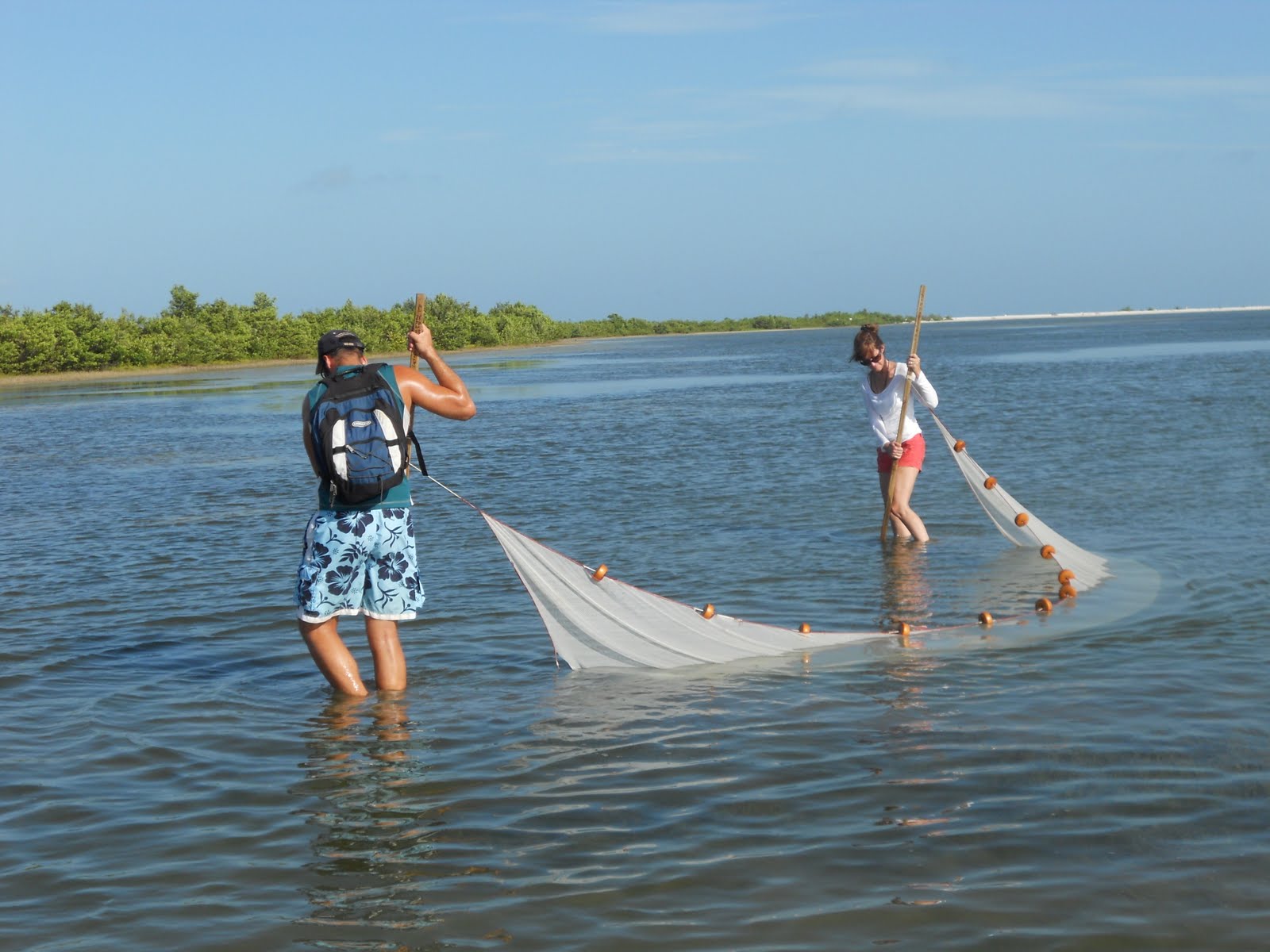
The kids caught whiting and ladyfish. Park ranger Barry Gorniak who has been helping me all week with the camp also showed a few of the kids how to throw a cast net.I think they really enjoyed that. Some kids fished the entire time, while others decided to just hang out and enjoy the warm water and sunshine. I also brought a seine net for the kids to collect fish. They had a blast with that. We caught lots of sardines, mojarras, whiting as well as a pipe fish and several juvenile lookdowns. Needless to say we (ok me) were exhausted by the end of the day, but it was well worth it!!
Tuesday, July 13, 2010
Collier County Youth Sport Fishing Camp Day 2
Today members of the Backcountry Flyfishing Club of Naples stopped by to teach our students about fly fishing. These guys are great! The students lenared how to tie their own flies and practiced casting with a fly reel (something I'll admit I can't do!). They did a great job, and were excited about the flies they made and got to keep. Big thanks goes out to the club members!!!
Following the fly fishing demos, we went back out to the lake for some more fishing. We used live and plastic worms today. Overall, the bite wasn't great, but towards the end, it picked up. The students caught several blue gill and redear sunfish. One student caught a Mayan cichlid. I was glad some of the kids got the opportunity to use a dehooking tool to release their fish.We then headed back inside and played a game called "Casting for Conservation". Students try to catch laminated fish with magnets attached to them and reel them in. If they catch a fish, they have to identify it, measure how long it is, and then look in the fishing regulations to see if it is a legal fish. Its a great way to have the students practice short casts while learning fish identificaiton, and how to read and follow the state's fishing regulations. Talk to you later!!!
Following the fly fishing demos, we went back out to the lake for some more fishing. We used live and plastic worms today. Overall, the bite wasn't great, but towards the end, it picked up. The students caught several blue gill and redear sunfish. One student caught a Mayan cichlid. I was glad some of the kids got the opportunity to use a dehooking tool to release their fish.We then headed back inside and played a game called "Casting for Conservation". Students try to catch laminated fish with magnets attached to them and reel them in. If they catch a fish, they have to identify it, measure how long it is, and then look in the fishing regulations to see if it is a legal fish. Its a great way to have the students practice short casts while learning fish identificaiton, and how to read and follow the state's fishing regulations. Talk to you later!!!Monday, July 12, 2010
Collier County Youth Fishing Camp- Day 1
Today, I began my youth sport fishing camp for Collier County Parks and Recreation. This is the 2nd year I've done the camp for them. We meet 9AM-1PM everyday this week. We've got an enthusiastic bunch of young anglers ranging from 8-10 years of age. Besides teaching the group basic fishing techniques (knot tying, casting,) I really try to emphasize the importance of being a conservation-minded angler. For instance, I make sure everyone knows how to use a dehooking tool before we fish for real. I addressed the benefits of using circle hooks, proper handling and release practices, and the importance of knowing and following the regulations. Of course we also did a little fishing too!! I get rods and reels donated from Fish Florida, which has alway been an excellent partner in supporting youth fishing education! Overall, fishing was a little slow today. We ended up only catching 4 or 5 bass. I think it was just too hot outside. The kids were good sports about it. Here are some pictures from today. Enjoy!
Thursday, July 8, 2010
Another Successful Florida Master Naturalist Field Trip: Trawling in Rookery Bay
I wasn't sure if the weather was going to cooperate, but we ended up having a great boat ride for our last Florida Master Naturalist field trip last night. It doesn't hurt that we have a very enthusiastic and knowledgeable class, which always makes a field trip even better!!
We took out one of Rookery Bay's mullet skiffs to do some trawling and examine local marine life up close. We pulled a small otter trawl, which is a type of fishing net that is dragged along the bottom behind the boat(FYI we have a perrmit to do it, and we don't trawl in areas with sensitive bottom habitats such as oysters or seagrass-we trawl over sandy/muddy bottom where there is an active current) . The mouth of the net is held open by two large wooden "doors" that are attached to either side of the net, and kept a apart by the water pressure. In front of the net opening is a metal "tickle" chain that drags along the bottom and spooks up critters into the net.
We ended up doing 2 trawl and brought aboard several critters including a sea nettle jellyfish, a 9-armed sea star, banded brittle stars, brief squid, snapping shrimp, mojarras, hardheaded catfish, lane snapper, porcelain crabs, mud crabs, tunicates, comb jellies, slipper shells, encrusting bryozoans, sauerkraut bryozoans, and sponge pieces. After the trawls we visited an active bird rookery in Rookery Bay proper. It was quite a site-dozens of egrets, ibis, pelicans, cormorants and herons congregating on a tiny mangrove island! I know the picture of the rookery isn't that great, but we made sure to keep a respectable distances from it so as not to disturb the birds. We actually had great bird sitings all evening: roseate spoonbills, black and yellow crowned night herons, green herons, great and snowy egrets, tri-colored herons, 1 pilleated woodpecker, least terns, black skimmers, etc!
Tuesday, July 6, 2010
New Saltwater Fishing Regulations Available On Line
Attention Anglers! The new state saltwater fishing regulations (July1-December 31, 2010) can now be found online. There are several changes for this edtion of the regulations. The shoreline fishing license is now free, but still required. Snook and lobster permits have both increased in price. There are also changes regarding bonefish, red snapper, and swordfish. Lemon sharks have also been added to the prohibited species list. Happy fishing!!
Thursday, July 1, 2010
Resident Shoreline Fishing License now Free!
Since August 1, 2009 Florida residents (with certain exemptions) have been required to possess a saltwater shoreline fishing license if fishing from natural shorelines, piers, jetties, bridges, floating docks, or similar structures. Although the license is still required by law, starting July 1, 2010, the license is FREE to resident anglers!! The state implemented the license last year to comply with federal regulations and to avoid anglers having to pay for a more expensive federal license. However, the state legislation repealed the fee during their last session. Anglers who order the license over the phone or via the Internet will still have to pay a processing fee. The shoreline license and other required licenses and permits can be purchased online at www.fl.wildlifelicense.com, at county tax collectors' offices, many retail outlets that sell fishing and hunting supplies, or by calling toll-free 888-FISH-FLORIDA (347-4356). Keep in mind there are several exemptions associated with who does and does not need a fishing license in Florida. For more information visit: http://www.myfwc.com/License/Index.htm.
Florida Master Naturalist Field Trip to Tigertail Beach


Last Saturday I took my Florida Master Naturalist class to Tigertail Beach on Marco Island. If you have never been to Tigertail, its a must see in Collier County!! Its a great example of how dynamic and diverse coastal environments can be. Its got mangroves, seagrassess, mudflats, coastal strand, dunes, and beaches!We first explored the lagoon by doing a little bird watching. We sawWilson plovers, black skimmers, white ibis, reddish egrets, great egret, snowy egret, laughing gulls, and osprey. Next we did a little species sampling by pulling seine nets through the seagrass, one of my favorites. We collected pinfish, pipefish, anchovies, scaled sardines, sheepshead minnows, goldspotted killifish, silversides, mojarras, mullet, mosquitofish, longnosed killifish, sailfin mollies, and Gulf killifish. We also collected lots of shriimp and swimming crabs, ceriths, coffebean snails, crown conchs, and lightning whelk.We then headed over to the beach side to seine some more; this time in the surf. I like to have students compare and contrast what we catch in the nets when sampling in different environments. The diversity, as expected was much lower than in the seagrass. We caught whiting, pinfish, mojarra, scalled sardine, silverside, and one tiny mullet!!! After seining the class dug for mole crabs and coquina clams, which neither were in short supply!! It was another great trip. A big thanks for Brooke Carney from Rookery Bay who helped me lead the trip, in addtion to our excellent, knowledgeable, and self-motivated class who made the trip a success as well!!!
Subscribe to:
Posts (Atom)