Florida Sea Grant Extension in Collier County

Welcome to the Collier County Sea Grant Extension Blog

This blog is an opportunity for me to share with you my extension outreach efforts and useful information to make you a more informed coastal citizen. If you have any questions about what you see, feel free to contact me at fluech@ufl.edu.


Search This Blog

Thursday, March 15, 2012

Florida's Top Omega-3 Fatty Acids-Seafood

One of the most recognized health benefits associated with eating seafood are Omega-3 fatty acids. These important substances are essential fatty acids that are required for healthy human development, but can't be manufactured by the body. They need to be obtained through food, and
fish and shellfish are considered to be the main dietary source.
Omega-3 fatty acids are important because help promote healthy brain and eye development in children and reduce heart disease in adults. U.S. health experts recommend a daily intake of 250 mg of Omega-3 fatty acids for the general population and 1000 mg for people with heart disease, and pregnant or breastfeeding women. Oily fish such as salmon, herring, and sardines are high in Omega-3 fatty acids. While these fish can usually be found in most retail stores in Florida, they are not caught or raised locally.
So how do some of Florida's top seafood species rank in Omega-3 Fatty Acids? The following list was compiled by seafood specialists with the University of Florida. Enjoy!


Approximate value for 4 ounces of raw, edible portions
Species
Omega-3
 Fatty Acids
(mg)
Amberjack
260
Bluefish
770
Catfish (farm-raised)
370
Clams
150
Blue crab
320
Stone crab (cooked 3 oz)
N/A
Flounder
210
Grouper
260
Spiny lobster
380
King mackerel
300
Spanish mackerel
1100
Mahi-Mahi
110
Mullet
350
Oysters
610
Scallops
200
Shark
870
Shrimp
490
Snapper
320
Swordfish
830
Tilapia
320
Tilefish
430
Yellowfin tuna
230

Source: Sullivan, A.L. and Otwell, W.S. 1991
A Nutrient Database for Southeastern Seafoods: A Comprehensive Nutrient and Nomenclature Handbook for Selected Southeastern Species. Composition of Foods: Finfish and Shellfish, USDA Handbook 8-15


To learn more about the health benefits of seafood visit:
http://seafoodhealthfacts.org/

Sunday, March 11, 2012

FMNP Field Trip with Fish-Tale Marina


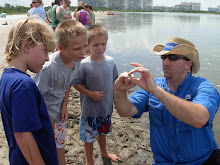
On Friday we took the 2nd field trip of our Florida Master Naturalist-Coastal Module. Thanks to the generous support of FishTale Marina we went out on one of their boats to do a little bird watching in the Estero Bay area. It was a great opportunity  to see several wading and waterbirds as well as learn about a variety of human-use issues in the area (e.g. poll & troll zones, shorebird nesting areas,  renourishment projects etc.). Of course, I can't leave out that we also saw manatees and dolphins! We couldn't have asked for better weather! After exploring the bay Captain Jay took our group to the southern end of Ft. Myers Beach where we did a little beach and lagoon exploration. We found crown conchs, blue crabs, fiddler crabs, lightning whelks, and worm egg sacks to name a few. Below is a list of birds we saw and several pictures from our trip. Enjoy!

(March 9th, 2012 Bird List)
Osprey, bald eagle, brown pelican, kingfisher, grackle spp., wood stork, great egret, reddish egret, snowy egret, great blue heron, little blue heron, tri-colored heron, white ibis, red breasted merganser, double crested cormorant, anhinga, ring billed gull, laughing gull, royal turn, ruddy turnstone, black vulture,  turkey vulture, palm warbler, and mocking bird.


Studens looking for a manatee spotted by some of the boat slips.
Joy giving the group an overview of what we'll be doing for the day.

Our class checking out some red breasted mergansers in Estero Bay.

Scouting out the mud flat up ahead for shorebirds

Joy explains to the group about proposed "poll and troll" zones to protect the bay's seagrass communities.


Captain Jay talks to our students about the dolphins commonly seen in the Estero Bay area

Just a few of our feathery friends we saw while out on the water
(brown pelicans, cormorants, ruddy turnstones, and laughing gulls)

The group checking out some dolphins in the bay.

Several bald eagles were spotted on Lovers Key. Joy is pointing out their next.

Lagoon and beach habitat on Ft. Myers beach


Exploration time!
I show the group a polychaete (marine worm) egg sack

A patch of shoal grass in the lagoon

A nice sized crown conch


Some young black mangroves that have established themselves along the shoreline

Nice lightning whelk!

Exploring the flats

Pneumatophores associated with black mangroves

Its not a field trip unless you get to hold a blue crab!!!!!!

Monday, March 5, 2012

Tarpon Genetics Recapture Study Video

Hey tarpon anglers...Watch and learn how to participate in the Tarpon Genetic Recapture Study.
http://www.youtube.com/watch?v=qzDwh5HcpJA&feature=colike
You'll get a step-by-step look at how to take a tarpon DNA sample and submit it to the Florida Fish and Wildlife Conservation Commission (FWC). Researchers from the FWC and Mote Marine Laboratory use these samples to identify and track individual tarpon and learn about where they live, how far they travel, and how often they are recaptured. Participating anglers are kept up to date on results through annual newsletters and recapture letter notifications. To find out more about the study, including how to get involved, visit http://myfwc.com/research/saltwater/tarpon/genetics/

Friday, March 2, 2012

Puffer or Burr??

Perhaps some of the most interesting and favorite organisms to catch while seining in seagrass beds are puffer and burrfish. Because both of these species can inflate themselves as a defense mechanism, they are often generally referred to as "puffers". There are, however, differences between the two, and in fact they come from different families.

Pufferfish are members of of tetraodontidae family. They do not have any visible spines on their skin. The "tetra" in the family name refers to the four large fused teeth (2 on the top 2 on the bottom) that are used help the fish feed on crustaceans and mollusks. While several species can be found in southwest Florida, one of the most common is the Southern pufferfish (Sphoeroides nephelus).  They have a brown body which is paler below, and are adorned with a variety of darker and lighter spots and blotches. They also have tan rings and semicircles on their body. For a full description of the Southern pufferfish's biology and life history visit: http://www.sms.si.edu/irlspec/Sphoeroides_nephelus.htm


Burrfish are members of the diodontidae family. Unlike pufferfish they do have a series of spines covering their body. The "di" in the family name refers to the two large fused teeth (1 on the top and 1 on the bottom) that are used to help feed on crustaceans and mollusks. The most common burrfish species we see in southwest Florida is the striped burrfish (Chilomycterus schoepfii). They are light tan to yellow-brown above and white to yellowish and sometimes blackish below. In addition to spines that cover their body, they have a series of wavy and roughly parallel lines on the side of their body. For a full description of the striped burrfish's biology and life history visit:
http://www.sms.si.edu/irlspec/chilomycterus_schoepfii.htm


Monday, February 20, 2012

Why does the commercial sector get to keep gag?

Image credit: Captain Tom Marvel
 Gag grouper has been a frequent headliner in recent months because of changes to the 2012 Gulf recreational fishing season. Needless to say recreational fishermen haven't been too happy with the rules.  Among other things, I have been getting questions regarding the commercial harvest of gag grouper in light of the new management actions. Specifically, why does the commercial sector still get to fish for gag if the recreational sector does not, and why are commercial fishermen now allowed to catch smaller gag than in the past?  Both are great questions, but first a little background.
  Based on the 2009 stock assessment NOAA fisheries determined the Gulf gag grouper stock was undergoing overfishing and overfished. As a result the Gulf of Mexico Fishery Management Council was required, by law, to end the overfishing of gag within two years of this determination and rebuild stocks to sustainable levels within 10 years. The Council implemented Reef Fish Amendment 32 which established a schedule and strategy to rebuild gag stocks for both the recreational and commercial sectors.

As to why the commercial sector still gets to fish for gag, it helps to understand how the commercial grouper fishery is managed. The commercial harvest of Gulf grouper in the Gulf is managed under an Individual Fishing Quota (IFQ) or “Catch Share” Program. In this system, fishermen own a number of limited shares that represent a percentage of each year’s annual catch limit instead of fishermen racing against one another to catch as much fish as they can during a defined season until a total quota is reached.  As long as fishermen don’t exceed their individual quotas, they can fish throughout the year in federal waters, which is where the majority of commercial grouper fishing occurs anyway. Therefore, it is possible to have commercial fishermen harvesting gag during a time period when recreational anglers are not.

To comply with the goals of the gag rebuilding plan, managers decided to set the commercial quota at 86% of their annual catch target. This adjustment was made because there are a limited number of gag shares available, and commercial fishermen who target other grouper species will inevitably continue to catch and discard gag under the limited IFQ system. Gag grouper is often caught by the commercial sector as bycatch while targeting red and other grouper species. Unlike red grouper, the commercial sector actually harvests less gag than the recreational sector does in the Gulf (61% goes to recreational vs. 39% to commercial).

In regards to why the commercial sector gets to harvest smaller fish, commercial fishermen, on average, fish for grouper in deeper waters, than recreational anglers. Fish caught in deeper water have a greater chance of dying upon release than fish caught in shallower waters. This is known as release mortality. According to the Gulf Council, gag release mortality in the commercial fishery can average 67%. The decision to decrease the commercial size limit of gag grouper from 24 to 22 inches was meant to reduce the gag release mortality rate, and prevent the wasteful discard of dead fish that would otherwise be thrown back because of a larger size limit. Because the fishery operates under an IFQ system where a fisherman cannot exceed his/her allotted share, a size limit reduction for the commercial sector would not equate to an increase in total commercial harvest.

If you would like to learn more about current grouper management efforts in the Gulf visit:http://sero.nmfs.noaa.gov/sf/pdfs/Gulf_Grouper_FAQs_021012.pdf

Monday, February 13, 2012

Have You Seen This Box Jelly?

I was recently sent an email from a colleague of mine at Rookery Bay regarding box jellyfish sightings in our area. Typically, when people hear "box jelly", they think of the highly venomous cnidarians found in Australia. However, there is also a box jellyfish that inhabits the waters of southern Florida. The tiny box jelly (Tripedalia cystophora) is  only a few centimeters in length and has clusters of three "pedalia" (tentacles) at each corner of its box-shaped body. It also has complex eyes which appear as small dark spots. Unlike its potentially lethal Australian cousins, this species is thought to be harmless to humans, and thrives in mangrove fringed waters of the Gulf of Mexico and Caribbean Sea. If you come across any of these, you are encouraged to report your sightings to Evan Orellana at e_orellan@hotmail.com or 954-675-5625. Click on the image below for details.


Wednesday, February 8, 2012

Recording of Florida Blue Crab Webinar


Did you know the blue crab fishery is one of Florida's top 10 commercial fishieres, and that in 2010 fishermen landed over 8 million pounds of the tasty crustacean worth an estimated $10.3 million? Want to learn more?

Today my colleagues kicked off the first session of our 2012 Florida Seafood Brown Bag Webinar Series. The purpose of the series is to: 1) educate seafood lovers about the sustainability and safety associated with some of Florida’smost commercially valuable seafood products & 2) help consumers make informed decisions about purchasing and eating Florida seafood.

Our first session was on Florida's blue crab fishery. We provided an overview of basic blue crab biology and life history, the importance of the blue crab fishery to the state and how its managed, and basic purchasing and handling practices. If you would like to view the recording of the webinar click HERE.*

*CORRECTION (2/18/12): I wanted to make you aware that I made a mistake during the blue crab webinar. When discussing the trend in commercial landings I made a comment that the drop in landings and trips was a result of (other than fluctuations in environmental factors)the 1998 moratorium on endorsement holders and the implementation of the blue crab effort management plan in 2007. This is not true. Dr. Ryan Gandy a research scientist with FWC's Fish and Wildlife Research Institute, caught the mistake and helped clarify the issue. 
 "When catch is low trips follow suit as crabbers put less effort to crabbing when they are negative financial returns due to low crab abundance, during low rainfall years. There is a big coincidence of the low rainfall, low landings and reduced trips all occurring when management action occurred. When the moratorium on new licenses went into effect this did not reduce the number of fishers in the fishery; it merely held that number at the existing level by not issuing new endorsements. When the effort management and trap tag program went into effect (2007) it facilitated the removal of unused latent endorsements but these (as implied) were not fished. We now have a known number of fished endorsements and traps. Only latent effort has been reduced."

The program we use is called Blackboard Collaborate. To make sure you have the necessary software to view and listen to the webinar, please visit: http://support.blackboardcollaborate.com/ics/support/default.asp?deptID=8336&task=knowledge&questionID=1251

 Let us know how we did!
 If you watch the recording, we'd love to get your feedback. Below is a link to a short survey that will provide us feedback about the session. https://www.surveymonkey.com/s/NDQHTH2


Finally, if you would like to view the recordings of past webinars click HERE.


During the webinar, we provided several blue crab-related resources. I've included the URL's below as well.

Florida blue crab recreational fishing regulations:
         http://myfwc.com/fishing/saltwater/regulations/blue-crab/

Preparing Blue Crab: A seafood delicacy


           http://edis.ifas.ufl.edu/sg078
Blue crab life Service history and processing video from the University of Georgia Marine Extension: 

Blue crab educator resources  from the Smithsonian Environmental Research Center:  http://www.serc.si.edu/education/resources/bluecrab/

Youtube video on peeler crabs and shedding tanks:                                       http://www.youtube.com/watch?v=3BnyWoMryp4

Blue crab buying information and  recipes from the Florida Department of Agriculture and Consumer Services: 

Friday, February 3, 2012

Jimmy, Sook, and Sally

Image credit: Bryan Fluech
The blue crab, or Callinectes sapidus, is a common inhabitant of Florida's estuaries and can be found in a variety of fresh, brackish, and saltwater habitats. This highly sought after crustacean helps support a multi-million dollar commercial fishery, and is also a popular catch for many recreational fishermen.


Image credit: FWC
In Florida, egg-bearing females are illegal to take as they obviously play an essential role in sustaining blue crab populations. These crabs are easy to identify by the large gray to orange mass cradled underneath the crab in its abdomen or "apron." Each sponge can hold millions of eggs. While it is not illegal to harvest females that do not have eggs with them, many fishermen chose not to harvest any females because of their importance to the fishery. Fortunately, by looking at the color of the claw tips and shape of the apron, fishermen can easily distinguish between male and female crabs.


Jimmy
 A male blue crab is known as a "Jimmy." They have blue tipped claws and their apron can be described as being shaped like the Washington monument or an inverted "T". Jimmies can be found throughout the estuary and also travel in to fresh water.


Image credits: FWC


Sally
An immature female blue crab is called a "Sally" or "she crab". Like a mature female she will have orange to red-colored claw tips, but the shape of her apron is different. The apron of a sally is triangle-shaped. It can also be thought of as an  inverted "V". Because she has not reached sexual maturity yet, the apron will be tightly sealed.


Image credits: FWC
Sook
Finally, a mature female blue crab is known as a "Sook". She too will have orange to red-colored claw tips, but her apron is more bell shaped. It is often said it likes the dome of the U.S capital building. She will hold her eggs (or sponge) within this apron. Females crabs can be found throughout the estuary as well as offshore in higher salinities.
Image credit: FWC

If you would like to learn more about blue crabs visit: www.bluecrab.info/