Florida Sea Grant Extension in Collier County

Welcome to the Collier County Sea Grant Extension Blog

This blog is an opportunity for me to share with you my extension outreach efforts and useful information to make you a more informed coastal citizen. If you have any questions about what you see, feel free to contact me at fluech@ufl.edu.


Search This Blog

Friday, October 1, 2010

Red Snapper and Turtle Season News Releases

There has been lots of news lately regarding two very important species associated with Florida's marine waters-red snapper and sea turtles. I wanted to share with you the news releases that FWC put out today.

Florida sea turtles have productive 2010 nesting season

According to the Florida Fish and Wildlife Conservation Commission (FWC), all three species of sea turtles that nest regularly on the state’s beaches had annual nest counts well above average for the previous 10 years. This news is especially good for loggerhead sea turtles, which have experienced declines in nesting in recent years. Loggerheads, the species that most commonly nests in Florida, had nest counts that were 30 percent higher than the 10-year average.
“We’re encouraged by the high count, especially considering the oil spill and the extreme cold weather earlier in the year,” said Dr. Blair Witherington, an FWC Fish and Wildlife Research Institute scientist. “However, one good year can’t reverse a declining trend. It will take many years of data to determine if this is a new nesting trend – obviously one that we would like to see continue in the future.”
Nest numbers for leatherback and green sea turtles also continued to increase, with nests in 2010 totaling the second-highest since standardized counts began in 1989.
Nest counts are performed each year through Florida’s Index Nesting Beach Survey, which was created to measure seasonal sea turtle nesting, and to allow for accurate comparisons among beaches and years. The standardized index counts take place on 248 miles of selected beaches along both the Atlantic and Gulf coasts. In one of the largest wildlife counts in the nation, hundreds of partners diligently survey Florida’s Index Nesting Beaches throughout the summer sea turtle nesting season. “It’s a big job that requires a dedicated group of nest-counting experts,” Witherington said. “It’s especially rewarding for those involved when the turtles make a good showing.”
FWC’s role in coordinating Florida’s sea turtle nest counts is funded by sales of the sea turtle license plate. For more information about sea turtles, including nesting information, visit MyFWC.com/SeaTurtle. Sick or injured sea turtles can be reported by contacting the FWC Wildlife Alert Hotline at 888-404-FWCC (3922). To view this press release online visit http://myfwc.com/NEWSROOM/10/statewide/News_10_X_SeaTurtlesNest2.htm.

Bonus recreational red snapper harvest weekends set to begin in Gulf

The recreational harvest of red snapper in Gulf of Mexico state and federal waters off Florida will be open for eight consecutive three-day weekends, beginning Friday, Oct. 1. The Florida Fish and Wildlife Conservation Commission encourages anglers to enjoy these extra weekend fishing days for Gulf red snapper, which were made possible because harvest levels of these fish were lower than expected this past summer.
The regular recreational harvest season for red snapper in Gulf waters took place from June 1 until July 24 this year. This season was set based on projections of how many red snapper recreational anglers could catch without exceeding the annual harvest quota, which was established to help rebuild overfished stocks so that anglers can benefit from better red snapper fishing in the future.
However, the recreational fishing effort for Gulf red snapper by private and charter boats was much less than anticipated, due to the BP Deepwater Horizon oil spill, which resulted in fishing closures and cancelled fishing trips in federal and state waters off parts of Florida’s Gulf coast. Consequently, the Gulf recreational red snapper quota was not met during the regular season, which means more fishing days can be opened this fall.
Anglers, except for the captain and crew of for-hire vessels, may keep two red snapper greater than 16 inches total length per person on Fridays, Saturdays and Sundays beginning Oct. 1 and extending for eight consecutive weekends through Sunday, Nov. 21.
Updated information about red snapper management and regulations is available online at www.MyFWC.com/Rules (click on “Fishing – Saltwater”).


Wednesday, September 29, 2010

Gulf Oil Spill Workshop for Teachers


Brooke discusses the attributes of
 the loop current
Last night my colleague from Rookery Bay, Brooke Carney, and I held a workshop for Collier County school teachers on the Gulf Oil Spill. Sixteen elementary, middle, and high school teachers attended the program. Brooke delivered a presentaiton on the physical and chemical aspects of the Gulf oil spill while I covered the biological and ecological aspects. After the presentations we had the teachers participate in an oil spill simulation activity where they had to 1) create an oil spill, 2) use different methods to clean up the spill, and 3) tally up the "associated costs" for conducting their clean up. We took the activity from the Smithsonian multidisciplinary ocean curriculum. It was called "Pollution Solution". The nice thing about this activity is that it can be modified in various forms to meet many student levels. Teachers were also provided with a number of other activities they could use with students as well as web resources for them and their students. I know it made a very long day for the teachers, but really appreciate them coming. I can't thank them enough for their hard work and dedication to Collier County's students! Thanks.
this group had the task of cleaning up
oil out of an oyster bar


teachers practice removing
oil from their
"mangrove forest"

Teachers observe their
"oil spill"

Sunday, September 19, 2010

National Seafood Consumption Rate Drops Slightly in 2009

image credit: Katie Semon
NOAA
In 2009 the average U.S. citizen consumed 15.8 pounds of seafood, which is a slightly less than the 2008 amount of 16 pounds. This information is contained in a report recently released by NOAA's Fisheries Service entitled "The Fisheries of the Unitied States 2009".

In addtion, the report found.....
  • The U.S. continues as the third-ranked country for consuming fish and shellfish, behind China and Japan. In total, Americans consumed a total of 4.833 billion pounds of seafood in 2009, slightly less than the 4.858 billion pounds in 2008.
  • Shrimp remained the top seafood item of choice for the United States at 4.1 pounds per person, a level unchanged since 2007.
  • The average 15.8 pounds consumed per person in 2009 was composed of 11.8 pounds of fresh and frozen finfish and shellfish, 3.7 pounds of canned seafood, primarily canned tuna, and 0.3 pounds of cured seafood, such as smoked salmon and dried cod. The overall decline in average consumption per American was due to a decrease in canned seafood consumed.
  • Most of the seafood consumed in the U.S. was not caught in U.S. waters. About 84 percent of the seafood consumed in the U.S. is imported, a dramatic increase from the 66 percent just a decade ago.
  • Farmed seafood, or aquaculture, comprises almost half of the imported seafood. Aquaculture production outside the U.S. has expanded dramatically in the last three decades and now supplies half of the world’s seafood demand, according to the United Nations Food and Agriculture Organization.
  • America’s aquaculture industry, though vibrant and diverse, currently meets less than ten percent of U.S. demand for seafood. Most of the U.S. aquaculture industry is catfish, with marine aquaculture products like oysters, clams, mussels and salmon supplying less than two percent of American seafood demand.“This report demonstrates there is room for the U.S. aquaculture industry to grow,” said Schwaab. “NOAA is working to develop a new national policy for sustainable marine aquaculture that will help us narrow the trade gap and strengthen the entire fishing industry in this country.”

    “With one of the highest consumption rates in the world, the U.S. has the ability to affect the world fish trade,” said Eric Schwaab, NOAA assistant administrator for NOAA’s Fisheries Service. “NOAA supports rebuilding and sustaining wild fisheries populations and building a strong aquaculture program that can help the U.S. fishing industry gain a larger share of the U.S. market. Americans should know that buying American seafood supports our economy, as well as the high environmental and safety standards our fishermen meet.”
(source: NOAA Fisheries Press Release)


U.S seafood consumption since 1980: source NOAA

Thursday, September 16, 2010

Snook Seminar Reels Em' In!

Last night I hosted a snook seminar for anglers with the help of staff from FWC's Fish and Wildlife Research Institute and Captain Jesse Karen of Mad Snookin Charters. Fifty-four snook enthusiasts attended the program and based on the evaluations I received, they were not disappointed. I owe that to the excellent speakers!
Wendy Quigley, the Outreach Coordinator for FWRI started the evening off talking about the impacts of last season's cold spell on Florida's snook population. If you haven't already heard, FWC has decided to keep the west coast snook fishery closed until Sept 2011 due to being more severely impacted than Florida's east coast fishery. Anglers on the east coast will be able to target snook from September 17th until December 15th, and then their season will also be closed until next September. An important point Wendy made is that the state's snook cold kill assessment came not so much from the "dead fish counts" reported all over the state last winter, but more from on-going monitoring programs the state already has had in place such as the Marine Recreational Fisheries Statistics Survey, Everglades National Park’s recreational creel survey, and  snook acoustic tagging data.
 Wendy also mentioned that since the snook season will be closed for west coast anglers, FWC is allowing anglers to get a refund for their snook stamp. To learn about the details click here. (Keep in mind, however, that the funds from the purchase of the snook stamp go directly towards research on Florida's snook fishery. To learn more about how these funds are used click here.)

Next, Ron Taylor, the state's lead snook biologist gave an amazing presentation on the life history and biology of snook. If there is anyone in the state of Florida who knows about snook, it is Ron. I am still extremely grateful he agreed to come down and do the seminar. I think what struck me the most is that even  even after studying snook for 35 years he said there is still so much they do not know about snook!!
Instead of trying to give a complete overview of his presentation I thought I'd leave you with some of the interesting facts Ron told us about snook. (keep in mind this is only some of what Ron talked about!)
  • There are actually 5, not 4 species of snook in South Florida (Common, Tarpon, Small-scale Fat, Swordspine, and the Large-scale Fat)
  • There is more genetic diversity among the Atlantic coast snook stock than on the Gulf coast

  • Snook on the Atlantic coast grow significantly faster and older than snook on the Gulf coast
  • Spawning season on the Gulf coast is continuous from April through September while on the Atlantic coasts its from May through October
  • Females can spawn every 2 days during this time and on average, the number of eggs released is 1.25 million per batch! That's a lot of snook eggs!!!
  • Fertilized eggs require at least 27 parts per thousand salinity to float (they can spawn in fresh water but eggs won't be able to float and survive!)
  • Peak spawning occurs between 4PM and 9PM (lunar cycle and current are major factors)
  • All snook start off as males and as they get older change to female (the reversal process takes less than 90 days to complete). Most males in the population change to female by age 12, but not always. Some of the largest snook Ron and his group tagged were actually males)
  • Freshwater and wetland resources are critical to the protection of Florida's snook populations
  • Most snook in the population are approximately 7 years of age and less than 32" total length.
  • Gulf coast snook make more local movements within the same estuary while Atlantic coast snook make more extensive trips up and down the coast line.
Alexis Trotter, who is another FWC snook biologist gave an great summary of some of the current snook-related research projects the state is working on. One of the key points she made is that "everyone has their hand in snook research." A lot of the crucial information the state collects about snook comes from anglers who are willing to share their experiences, time, and sometime even their catch with researchers. For example the state has conducted over 30,000 interviews with over 61,000 anglers since 2002, The state also conducts independent research around the state targeting both juvenile and adult snook. To learn more about the research FWC conducts on snook and how you can get involved click here.

Finally, I can't forget Captain Jesse from Mad Snookin' Charters who shared with the audience what he's seen on the water since the cold spell, some of his techniques for fishing for snook, and more importantly proper practices for handling and releasing snook. It was very apparent Jesse "loves" his snook fishing and does everything in his power to ensure the fish he catches and releases survive and thrive. (for more details on proper catch and release practices click here.) Unfortunately his report on snook fishing in the the 10,000 Islands areas was not as promising as it has been in the past due, in large part, to last season's cold spell and perhaps other unknown factors.

Thank you to all the speakers for making the event successful and to attendees who were able to make it!!

Tuesday, September 14, 2010

2010 Southwest Florida Boating and Waterways Workshop

Attendees listen to Kevin Sharbrough
from the UF Levin College of Law
about non-economic tools to evaluate
marine infratructure


Last week my Florida Sea Grant Extension colleagues and I hosted the first annual Southwest Florida Boating and Waterways Management (BWM) Workshop in Punta Gorda, Florida. The idea for the workshop stemmed from feedback from stakeholders associated with BWM in the region over a year ago at a Florida Sea Grant strategic planning meeting in Cedar Key. Since it would be sometime before anotehr statewide BWM summit could be planned, a smaller, regional workshop would be an opportunity to keep stakeholders informed of current regulations, research, and funding opportunities of interest. It would also allow participants to network with one another on a regional scale. 
Thomas Ruppert, FSG Marine Policy
Specialist, talks about
waterfront community planning
Over 80 people representing local, state, and federal government agencies as well as private businesses, marine industries association, academia, citizen groups, and local advisory committees attended the day and half workshop. The goals of the workshop were to discuss innovative strategies to assist managers, planners, policy-makers, and other marine interests as they attempt to balance economic vitality with ecologically sound management practices along southwest Florida's waterways as well as increase professional networking opportunities among the participants.
The first day included a variety of oral presentaitons on topics such as FWC's statewide boating economic study,  non-economic tools to evaluate Florida's marine infrastructure, smalltooth sawfish management issues, permitting and regulatory considerations, derelict vessel management, infrastructure planning for sea level rise, Gulf oil spill response, waterfront community planning, and the Regional Waterway Management System. Day two  included a facilitated strategic planning session where participants had the opportunity to identify and prioritize waterway issues and discuss strategies to address them.( I have to give kudos to my colleague Joy Hazell, the Lee County Sea Grant Agent who did a fabulous job faciliating the session!)
Participants discuss key BWM issues
during the facilitated strategic planning
 session on day 2 of the workshop
We got an overwhelming positive response about the quality and value of the workshop from the surveys we distributed and it was clear the participants want to make the workshop an annual event. One of the initial impacts of the workshop is the development  of a regionwide network of boating and waterways professionals with similar interests and issues. Through the continued offereing of these workshop and other networking opportunities we are hopeful we (Florida Sea Grant) will continue to play an important role in bringing stakeholders together to collaboratively address and eventually solve some of Southwest Florida's most pressing boating and waterways management issues.

To learn more about the workhsop, click on the link below to see an aritcle written by Greg Martin of the Charlotte Sun.
http://scc.eed.sunnewspapers.net/Olive/ODE/charlotte_sun/LandingPage/LandingPage.aspx?href=U0NDLzIwMTAvMDkvMTE.&pageno=MTg.&entity=QXIwMTUwNw..&view=ZW50aXR5

Wednesday, September 8, 2010

Animation of Deepwater Horizon Surface Oil via Satellite Data

Recenty, I was emailed a series of teacher resources that the Center for Ocean Science Education Excellence Networked Ocean World (COSEE NOW) developed about the Deepwater Horizon Oil Spill. If you get a second check out their Powerpoints. They are very informative and educational, and a great resourece. One of the presentations showed a very cool animation created by NOAA's Environmental Visual Laboratory.  It shows the daily changes in satellite analysis of surface oil extents from April when the Gulf oil spill first started until July when it was capped.. To view the animation click here. Enjoy!

"It should be noted that the observed extents may in some cases not reflect the actual extents due to the difficultly in identifying oil slicks from space. For instance, medium resolution visible images are taken using sunglint data, whereby the sun’s angle creates a glare off the surface of the ocean. If the glare is not wide enough, not all of the plume will be seen. Oil-like sheens from algal blooms also complicate the matter. Very high resolution visible and synthetic aperture radar satellites also have very narrow swath coverage, so a large plume or patches of oil may extend past the bounds of the sensor’s detection area. For all of these reasons, the analysts at NOAA’s Satellite Analysis Branch must use all of the data available to generate a composite over a 24 hour period. Some days, not enough data is available to generate an accurate extent estimate, so those dates are missing from this time series. In addition, these extents show only the surface oil, not the subsurface plumes."

http://www.nnvl.noaa.gov/MediaDetail.php?MediaID=419&MediaTypeID=2

Friday, September 3, 2010

West Coast Snook Seaon Remains Closed: Proper Handling Practices More Important Than Ever

If you haven't heard already, FWC has decided to keep the snook season closed on Florida's west coast until September 2011. Biologists recently provided an update to the Commission on the impacts this year's cold spell had on snook populations and West coast snook faired a lot worse than those on the East coast. In fact, FWC decided to reopen the snook season on the east coast until December 15th when it would normally close. The one fish per angler daily bag limit and 28-32 inch total length slot limit will still apply. Once the season closes on December 15th, however, it will stay closed until September of next year as well. To see the full press release click here.

Although anglers will not be able to keep snook on the west coast, they will no doubt continue to catch them. It will be more important than ever for anglers that catches snook to properly handle and release them to help the west coast population rebound and thrive.

Simply catching and releasing a fish does not always guarantee its survival. Even when a fish is healthy, factors such as time spent fighting on the line and out of the water, where it is hooked, and how it is handled can determine whether a fish will survive once it is released. When a fish is not as healthy,such as some of the fish still recovering from last season's cold spell, these factors can play even a larger role in the fish's post-release survival rate.


Research has shown that the survival rate of fish caught and released with proper handling techniques is significant. By following these practices, anglers help improve the survivability of the fish they release.
  • Use tackle heavy enough to land a fish quickly. This reduces exhaustion, which can result in the death of the fish or weaken it, making it more vulnerable to predators or disease.
  • If using a landing net, use small mesh, knotless nets made of non-abrasive materials to reduce skin and scale damage and the loss of slime when landing the fish.
  • Fish should be handled gently and as little as possible. Never let fish flop on the boat deck or ground as this can cause scale and fin damage or internal injuries.
  • Only gaff a fish when you are sure it is legal to harvest and you intend to keep it. In this case, do NOT gaff ANY snook you catch!
  • Return fish to the water as quickly as possible to minimize stress. Dehooking devices can help remove hooks from a fish without removing it from water. If a fish must be lifted from the water, always support its weight horizontally and never lift a fish by its jaw; this can injure the fish so it can’t feed normally and/or harm its internal organs.
  • When you must handle a fish, use wet hands, and never a towel to prevent removal of the fish’s protective slime coating. Do not touch the gills or eyes and never hold a fish by its gill cover.
  • Consider using circle hooks when fishing with live or cut bait. Research has shown that circle hooks are more likely to hook a fish in the mouth rather than the gut, making them easier to remove and reducing harm to the fish. Bending down hook barbs can also reduce damage to the fish.
  • If a fish is exhausted, revive it before releasing by holding the fish with the head pointed downward in the water and moving the fish back and forth to pass water over its gills until the fish is able to swim unassisted.
To learn more about proper catch and release fishing practice, visit Florida Sea Grant's website at www.catchandrelease.org
If you would like to learn more about snook biology, impacts the cold spell had on the fishery, and ongoing research related to snook, Florida Sea Grant/UF Extension is hosting a snook seminar September 15th at Rookery Bay from 6PM-8PM. Click here for more information.

Monday, August 30, 2010

First Annual Pine Island Scallop Search a Success!!!!

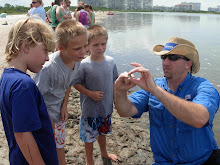
On Saturday I had the privledge of participating in the first annual Pine Island Scallop Search put on my colleague Joy Hazell, the Lee County Sea Grant Extension Agent and the Sannibel Captiva Conservation Foundation. The event is a resource‐monitoring program where volunteers snorkel, looking for scallops in select areas within Pine Island Sound. The purpose of this program is to monitor and document the health and status of the bay scallop population, and is modeled off of the successful Great Bay Scallop Search conducted in Tampa Bay since 1993. One hundred and twenty volunteers participated in the event and 335 scallops were counted!!! 
Unfortunately, we don't have many bay scallops in Collier County, but they are fascinating animals, and I must say absolutely delicious! I thought you'd enjoy some more information about them.

(Content take from Betty Staugler, Charlotte County Sea Grant Extension Agent) The Florida bay scallop is a bivalve mollusk that grows and lives in seagrass beds in relatively shallow water, 4 to 10 feet deep. At one time scallops could be found from Palm Beach to Pensacola. Today, consistently healthy populations can only be found in selected locations along Florida's West Coast - principally St. Joseph Bay, and the area between the Econfina and Weeki Wachee rivers.

In recent years, bays scallops have been seen in greater numbers in southwest Florida waters, in part due to restoration efforts in the area. With greater awareness of their recovery, unfortunately come many reports of illegal harvesting. Readers should be aware that recreational harvest of bay scallops is prohibited in all southwest Florida waters.

Legal Requirements
In Florida, commercial harvest of bay scallops is prohibited. Recreational harvest is allowed only in state waters from north of the Pasco-Hernando county line to the west bank of Mexico Beach Canal and only during a limited season, typically July 1 through September 10. For 2010, FWC allowed an early opening date, June 19, to provide economic relief to those counties which rely heavily on the tourism industry associated with scalloping and might be impacted by loss of revenue from perceived impacts of the oil spill. All other rules remained in place, including the boundaries of the approved harvest areas and the harvest limits.
For readers interested in traveling to the Big Bend during the recreational harvest season a few rules apply. In general, recreational scallopers between the ages of 16 and 65 must have a current Florida saltwater fishing license to collect scallops. There are some exceptions; these are listed in the FWC "Florida Recreational Saltwater Fishing Regulations," which is available in bait shops, FWC offices, or at the FWC web site. All non-residents over the age of 16 are required to buy a license unless they are fishing (scalloping) from a for-hire vessel (guide, charter, party boat) that has a valid vessel license

To learn more about the life history and ecology of bay scallops click here.
 
To participate in future bay scallop search events in Southwest Florida you can contact:
Betty Staugler: Charlotte County Sea Grant Extension Agent: 941-764-4340
Joy Hazell: Lee County Sea Grant Extension Agent: 239-533-7518
A bay scallop sits on the bottom of a sea grass bed
Healthy seagrass communities and good water quality are crucial to
having viable bay scallop populations
Add caption
The "eyes" of a scallop are a defining characteristic of the bivalve mollusk